Choosing Your First Chef's Knife: Expert Buying Guide
2026-05-17 · Emile
Sarah used to dread chopping onions. Every time, she'd grab the biggest knife from the block, a cheap, lightweight thing with a serrated edge she thought was "sharp." It would slide off the onion skin, crush the layers, and usually end with a teary struggle. She’d always assumed she was just bad at chopping. Then she visited a mate who had a proper chef's knife – a heavy German beast that sliced through a tomato with barely any pressure. That’s when it clicked. Her knife wasn't blunt; it was just a dud. She decided it was time to invest in her first real chef's knife, but where to even start?
If that sounds familiar, you're not alone. The world of chef's knives can be a confusing mess of jargon, marketing hype, and conflicting advice. As someone who sees hundreds of knives every week – the good, the bad, and the utterly ruined – I can tell you what actually matters when you're buying a knife that'll last you decades, not months.
What's a "Real" Chef's Knife, Anyway?
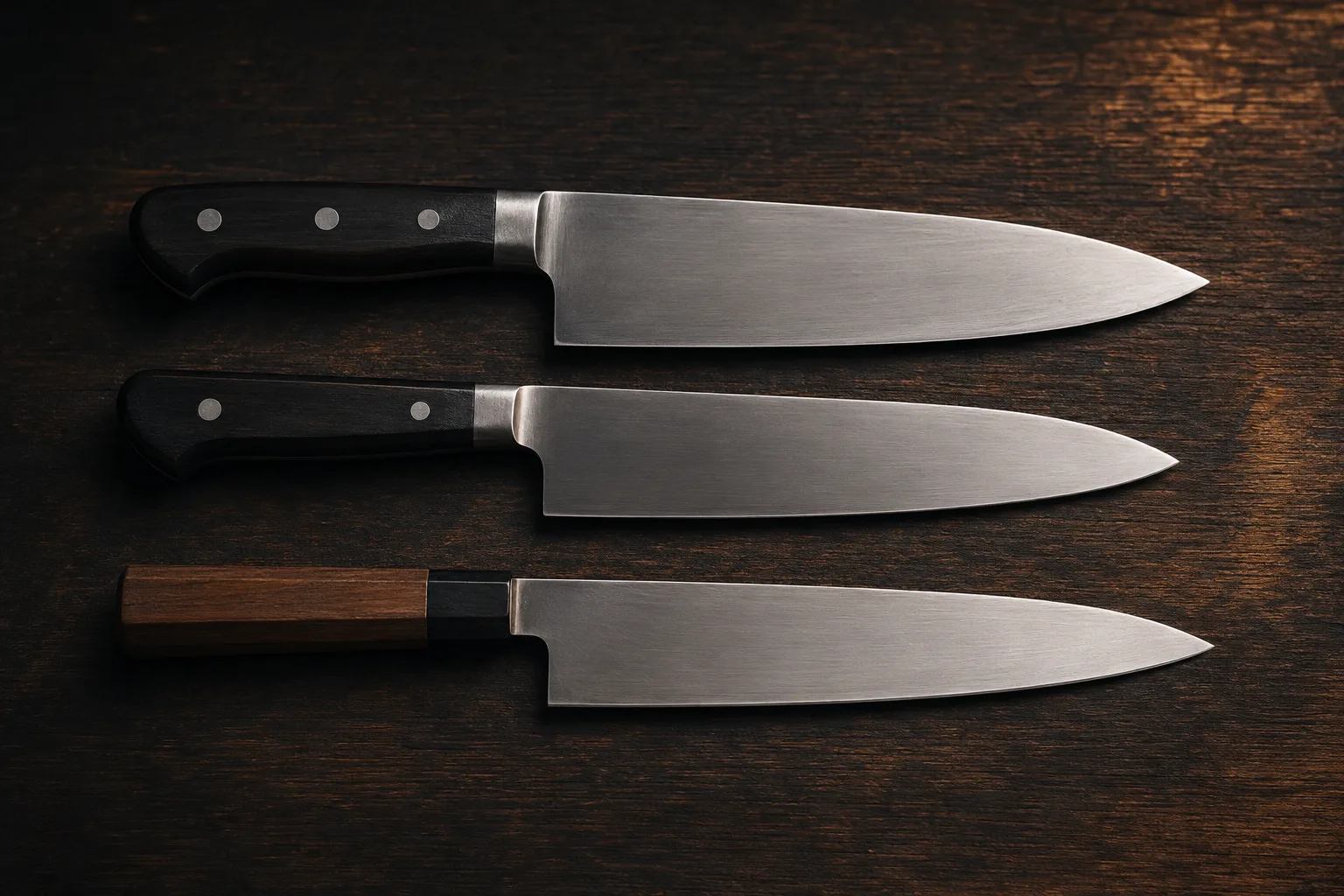
Forget those flimsy, stamped knives that come in a block set for fifty bucks. A real chef's knife is a workhorse, designed to be an extension of your arm. It's the one knife you'll reach for 80% of the time, whether you're dicing vegetables, slicing meat, or mincing garlic. It's not about flash; it's about performance and durability.
Most cheap knives are stamped out of thin sheets of soft steel, then given a basic grind. They're light, flexible, and lose their edge quicker than you can say "blunt." They also tend to be difficult to sharpen properly because the steel just isn't up to it. A proper chef's knife, on the other hand, is usually forged or laser-cut from a thicker, harder piece of quality steel. It has a specific geometry, a balanced feel, and most importantly, it can take and hold a genuinely sharp edge.
You'll typically be looking at knives 8-10 inches (20-25cm) long for a general-purpose chef's knife. Anything shorter and you'll struggle with larger items like cabbages or roasts. Longer, and it might feel unwieldy if you're not used to it. The key is that it feels comfortable and inspires confidence in your hand.
Forget the Gimmicks: Focus on Steel
This is where the rubber meets the road. The steel is the heart of your knife. You'll hear terms like "high carbon," "stainless," "Damascus," "VG-10," "AUS-8," "X50CrMoV15" – it can be a lot. For your first good chef's knife, I'd generally recommend a good quality stainless steel. Why?
- Durability and Maintenance: Good stainless steels (like those used by Wüsthof, Victorinox, or Global) offer a great balance of edge retention and corrosion resistance. They won't rust if you forget to wipe them down immediately, which is a common rookie mistake with carbon steel.
- Edge Retention vs. Brittleness: Steel hardness is measured on the Rockwell HRC scale. German knives usually sit around 56-58 HRC. They're tough, a bit more forgiving if you accidentally hit bone, and hold a good working edge. Japanese knives often range from 59-64 HRC. They can get incredibly sharp and hold that edge longer, but they are also more brittle and prone to chipping if mishandled or used on hard surfaces. For a first knife, a slightly softer, tougher steel often makes more sense. You want something that will stand up to daily use without constant worry.
Avoid anything that feels suspiciously light and flimsy. A good knife should have some heft and rigidity. The steel should be consistent from spine to edge. If it bends easily with light pressure, it's not going to hold an edge for long, no matter how much you sharpen it.
Edge Geometry: The Angle Matters
When you get a knife sharpened, we're talking about putting a precise angle on the edge. This angle is its geometry, and it dictates how well the knife slices and how robust the edge is. Generally, you'll see two main styles:
- German/Western Style: Typically sharpened to an angle of 18-20 degrees per side (36-40 degrees inclusive). This creates a robust, durable edge that can withstand a bit of abuse. Knives like Wüsthof Classic or F. Dick ErgoGrip fall into this category. They're designed to chop and push through ingredients.
- Japanese Style: Often sharpened to a much finer angle, around 12-15 degrees per side (24-30 degrees inclusive). This creates an incredibly sharp, precise edge that glides through food with minimal resistance. Brands like Shun, Global, or Tojiro usually feature these finer angles. While sharper, these edges are also more delicate and prone to chipping if used incorrectly or on hard surfaces.
For your first real chef's knife, either is a good choice, but understand the trade-offs. The German style is more forgiving. The Japanese style requires a bit more care. What's crucial is that whatever knife you choose, you get it sharpened by someone who understands these differences and can maintain the correct angle. Our water-cooled sharpening system uses a precise angle jig, so whether it's a sturdy German workhorse or a delicate Japanese slicer, the bevel geometry comes out perfect every single time. No scalloping, no rounding, just a consistent, sharp edge.
Weight and Balance: Feel it Out
This is highly personal, and it's why I always recommend holding a knife before you buy it. A knife should feel balanced in your hand, not tip-heavy or handle-heavy. The balance point is often just where the blade meets the handle (the bolster, if it has one). A common way to test this is to pinch the blade just above the handle and see how it feels.
- Heavier Knives (German Style): Often have a full bolster (the thick part where the blade meets the handle) and a full tang (the steel extends all the way through the handle). This adds weight, which some chefs prefer as it provides a feeling of control and helps the knife "fall" through food. Wüsthof and F. Dick are classic examples.
- Lighter Knives (Japanese Style): Many Japanese knives, especially those with a thinner blade profile, are lighter. They often lack a full bolster, which allows for easier sharpening all the way to the heel of the blade. This lightness can make them feel more nimble and precise for delicate work. Global knives, with their seamless all-steel construction, are a good example of a lighter, well-balanced knife.
Ultimately, the best balance for you is the one that feels right. You should be able to hold the knife comfortably for extended periods without strain. Try a pinch grip (thumb on one side of the blade, index finger on the other, just in front of the handle) – this is how most professional chefs hold their knives, as it gives the most control.
Handle Material & Comfort
The handle is your connection to the blade, so comfort, grip, and hygiene are important. You'll find handles made from wood, various synthetic plastics, or composite materials. Each has its pros and cons:
- Wood: Traditional and beautiful, but requires more maintenance. It can swell, shrink, or crack if not properly cared for, and can sometimes harbour bacteria if not cleaned thoroughly. Some high-end wooden handles are stabilised, reducing these issues.
- Synthetic (e.g., Polypropylene, Fibrox): Durable, hygienic, and often textured for a non-slip grip, even when wet. Victorinox Fibrox handles are famous for their comfort and practicality – often seen in professional kitchens because they're no-nonsense and perform.
- Composite (e.g., Micarta, G-10): These materials combine resins with fabrics or other fibres to create extremely durable, stable, and often visually appealing handles. They offer good grip and are generally waterproof. Many Shun knives use D-shaped Pakkawood (resin-impregnated wood), which offers the look of wood with the durability of a synthetic.
Again, comfort is king. A handle that's too small, too large, too slippery, or has hot spots will make using the knife a chore. Make sure it feels secure and comfortable in your hand.
Brands You Can Trust (Mostly)
Instead of getting bogged down in endless choices, here are some reliable brands that consistently deliver quality for their price point:
- German Workhorses:
- Wüsthof: A classic for a reason. Their Classic range is a benchmark for forged German knives – sturdy, well-balanced, and excellent edge retention for their steel.
- F. Dick: Widely used by butchers and professionals, especially their ErgoGrip series. They’re built for serious work, durable, and comfortable.
- Victorinox: Don't let the price fool you. Their Fibrox Pro line offers incredible value. They're sharp out of the box, hold an edge well, and have fantastic, non-slip handles. A fantastic starting point for any serious home cook.
- Japanese & Hybrid Styles:
- Global: Distinctive all-steel design, lighter than German knives, and known for their sharp, precise edges. The dimpled handle offers surprisingly good grip.
- Shun: Often beautiful, very sharp, and feature harder steels (like VG-10). Their Classic line is a popular entry into Japanese-style knives for home cooks.
- Tojiro: Offers excellent performance for the price, especially their DP series. They're a great way to experience a true Japanese edge without breaking the bank.
Be wary of "designer" or "influencer" brands that pop up with flashy marketing but no real history or reputation. Stick to the established names, especially for your first serious purchase. You're buying a tool, not a fashion accessory.
The Lifespan of a Good Knife: Keeping it Sharp
Buying a great knife is only half the battle. To keep it great, you need to care for it. Always use a good quality cutting board (wood or high-density plastic – never glass, ceramic, or stone, which will dull your knife instantly). Wash it by hand immediately after use, and dry it straight away. Store it safely in a knife block, on a magnetic strip, or with a blade guard – rattling around in a drawer is a death sentence for a sharp edge.
Even with the best care, any knife will eventually dull. That's not a fault of the knife; it's just physics. When your knife starts to drag rather than slice, when it struggles with a ripe tomato, or when you find yourself pressing harder than you should, it's time for a professional sharpen. Don't wait until it's completely blunt. Regular maintenance makes the sharpening process quicker and preserves more of your knife's life.
At SharpenIt, we understand what a good knife needs. We use a slow-turning, water-cooled wheel paired with a consistent-angle jig. This means zero heat build-up, protecting the factory heat treatment of your knife's steel. No ruined edges. We then finish the edge by hand on a leather honing wheel with polishing compound. This isn't just "sharp"; it's razor sharp, the kind of edge you get from professional knife makers. Most budget services skip that crucial polishing step. For more tips on knife care, check out our FAQ section.
Whether you've just bought your first Wüsthof or you're finally replacing that old supermarket special with a Victorinox, getting it professionally sharpened is the best way to ensure it performs as it should. We make it easy with our mail-in service Australia-wide – we send you a satchel with postage paid both ways. If you're near Arcadia Vale, we offer local pickup and delivery for a small fee, with a 5-knife minimum. No fuss, just sharp knives, fast.
Ready to experience what a truly sharp knife feels like? Get your knives professionally sharpened. Place your order today.