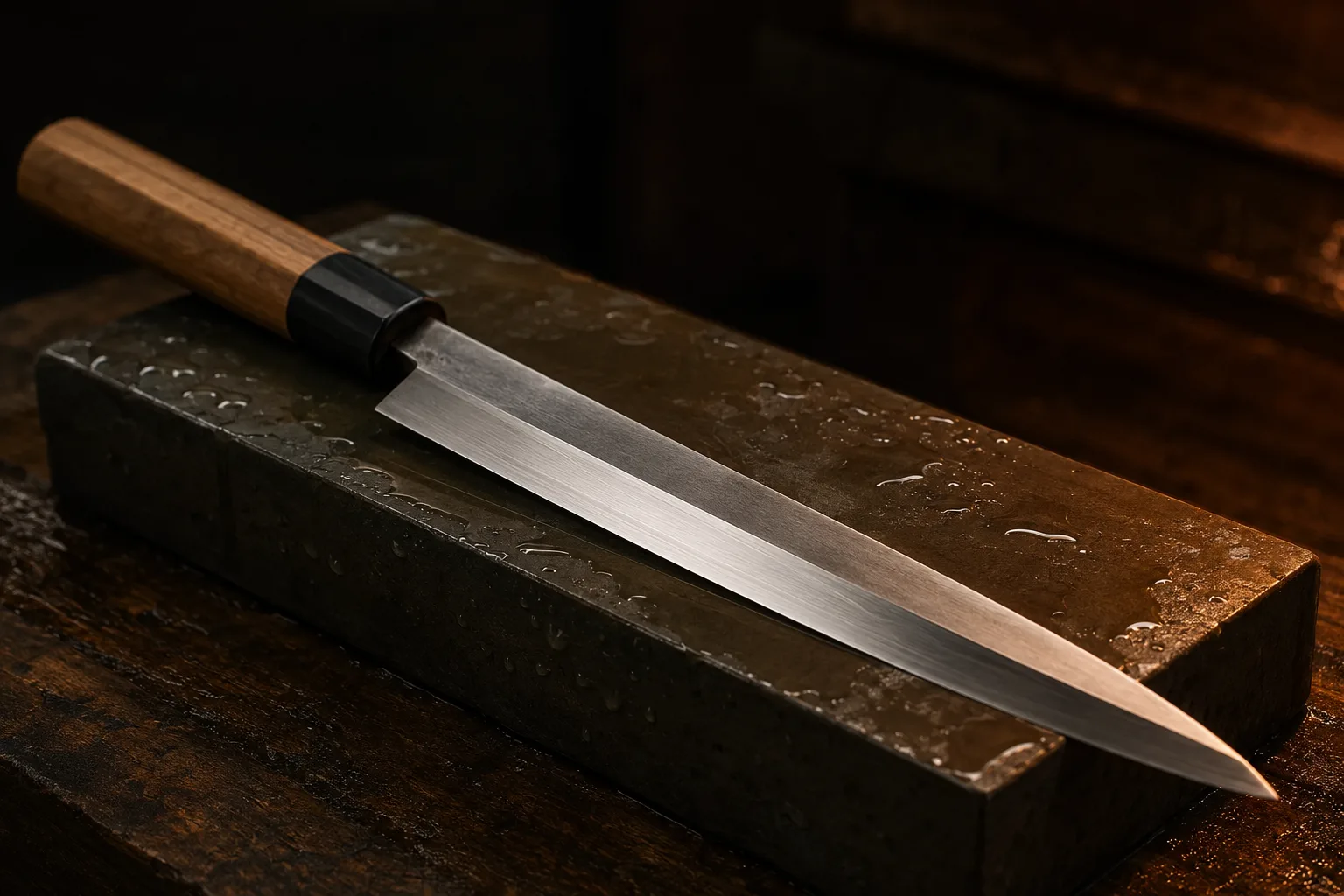
Sharpening Japanese Single-Bevel Knives: A Different Approach
2026-05-17 · Emile
If you think all sharp knives are created equal, you're in for a rude shock when it comes to Japanese single-bevel blades. Too many home cooks, and even some so-called professional sharpeners, treat a high-end Yanagiba or Deba like a regular Western chef's knife. That's a mistake that costs money and ruins good steel.
Japanese single-bevel knives – think your traditional sashimi slicers (Yanagiba), fish filleting knives (Deba), or vegetable choppers (Usuba) – aren't just fancy; they're fundamentally different in their design and function. They're built for precision, for specific tasks, and their unique geometry demands a specialized approach to sharpening. Try to sharpen one of these like a double-bevel Wüsthof or Victorinox, and you'll quickly destroy its performance, its balance, and ultimately, its life.
At SharpenIt, we see these knives come through our workshop regularly. Some are pristine, ready for a refresh. Others arrive with edges completely mangled by well-meaning but ill-informed attempts at sharpening. Understanding why these knives are different is the first step to keeping them in top condition.
What Makes a Single-Bevel Knife Unique?
The clue is in the name: "single-bevel." Unlike most Western knives and even many modern Japanese knives (like a Global or some Shun models which are symmetrical double-bevels), a true traditional Japanese single-bevel knife is ground with a bevel on only one side of the blade. The other side, the "back" or "ura" side, is flat or slightly concave.
This isn't just an aesthetic choice; it's a design for function. This asymmetry allows for incredible precision, extremely thin slices, and a unique cutting action that "steers" the food away from the blade. It's why a master sushi chef can prepare delicate fish with such artistry – the knife practically does the work for them, if it's correctly sharpened.
The Anatomy of a Single-Bevel Edge
- The Omote (Front Side) or Kireha (Blade Face): This is the primary sharpened side, featuring a wide, often complex bevel. This bevel dictates the cutting angle and the knife's ability to slice through ingredients with minimal resistance.
- The Ura (Back Side): This is arguably the most critical and misunderstood part. It's not flat in the way a plank of wood is flat. Instead, it features a subtle hollow grind (called an "urazuki") near the edge, leaving a thin, flat rim (the "urasuki" or "uraoshi") right at the very edge and along the spine. This hollow creates an air pocket that reduces drag and prevents food from sticking, while the flat rim acts as a reference point for sharpening and provides stability.
- The Shinogi (Spine Line): On many single-bevel knives, there's a distinct line where the primary bevel meets the main body of the blade. This line is important for maintaining the knife's original geometry.
Maintaining these distinct features is paramount. Every part has a job, and if you mess with one, the whole knife suffers.
Why Standard Sharpening Methods Will Ruin Them
Imagine trying to fix a complex engine with a hammer. That's what happens when you try to sharpen a single-bevel knife with methods designed for symmetrical, double-bevel knives. Most Western sharpening systems, be it a pull-through sharpener, a V-sharpener, or even a bench grinder, are designed to create a symmetrical V-shape edge by removing material equally from both sides of the blade.
Here’s why that's disastrous for a single-bevel:
- Destroying the Ura: Grinding the back side of a single-bevel knife with a flat stone or wheel will quickly remove the critical hollow grind (urazuki) and the flat rim (urasuki). This eliminates the air pocket, increases drag, makes food stick, and fundamentally alters the knife's cutting mechanics. Once that ura is gone, it's incredibly difficult, sometimes impossible, to restore correctly without significant blade thinning.
- Altering the Omote's Geometry: Trying to create a symmetrical bevel on the front side often means grinding away far too much steel, changing the angle, and ruining the delicate balance and precision the knife was designed for. The wide, shallow primary bevel on a single-bevel knife is not meant to be replicated by a steep, secondary bevel.
- Overheating Delicate Steel: Many Japanese knives use very hard, high-carbon steels (like Aogami or Shirogami) that are heat-treated to achieve incredible edge retention. Applying excessive heat, common with high-speed dry grinders, can damage this heat treatment, making the steel brittle or soft – a permanent, irreversible degradation.
The end result is a knife that might feel "sharp" in the crude sense, but it won't perform like it should. It will wedge in food, lose its steering ability, and effectively become a very expensive, poorly performing blunt instrument.
The SharpenIt Method for Japanese Single-Bevel Knives
Because of their unique construction and the precision required, sharpening a traditional Japanese single-bevel knife is a meticulous, time-consuming process that demands specific knowledge and equipment. It's why we classify them under our "Premium" sharpening service.
Our approach is rooted in the traditional methods, adapted with modern, precise tools to ensure the integrity of your blade:
1. Respecting the Ura
The first rule is to preserve the ura. We work the ura side minimally, ensuring that the tiny, flat rim (urasuki) at the edge is maintained and polished. This might involve a very light pass on a fine-grit stone, always ensuring the hollow grind isn't touched. The goal here isn't to create an edge, but to flatten and polish the micro-bevel on the ura to remove any burr created from the omote sharpening.
2. Precision Grinding the Omote (Front Bevel)
The bulk of the sharpening work happens on the omote. We use a slow-turning, water-cooled grinding wheel combined with a consistent-angle jig. This setup offers several critical advantages:
- Zero Heat to the Edge: Our water-cooled system physically prevents the blade from overheating. This is crucial for high-carbon Japanese steels, ensuring the factory heat treatment that allows the knife to hold its incredible edge remains completely intact. You won't find us burning the edge off your expensive knife.
- Perfect Bevel Geometry, Every Pass: The angle jig holds the blade at a fixed, precise angle, matching the knife's original geometry. This ensures the wide omote bevel comes out perfectly flat and even, without any scalloping, rounding, or over-grinding that removes precious blade material unnecessarily. This consistency means your knife's unique cutting performance is preserved, and future re-sharpenings will build on the same solid foundation.
3. Hand Finishing for Razor Sharpness
Once the primary bevel is established on the water wheel, the final, crucial step is done by hand on a leather honing wheel charged with polishing compound. This is the difference between "sharp" and "razor sharp." This final stage polishes the edge to an incredibly fine, mirror finish, removing any remaining micro-burrs and creating an edge that glides through food with minimal effort. Most budget services skip this step because it requires skill and time, but it’s non-negotiable for a truly premium edge.
This meticulous process is why single-bevel knives cost more to sharpen – it's skilled hand-work, not just running a knife through a machine. The $30 premium reflects the time, expertise, and care required to restore these specialized tools without damaging them.
Caring for Your Single-Bevel Knife at Home
While professional sharpening is essential, you can extend the life of your edge with proper home care:
- Gentle Cleaning: Always hand wash your knife immediately after use with warm, soapy water. Dry it thoroughly to prevent rust, especially with high-carbon steels. Never put it in the dishwasher.
- Proper Storage: Store your knife in a knife block, on a magnetic strip, or in a saya (sheath) to protect the delicate edge from accidental bumps and knocks.
- Honing (Carefully!): You can use a very fine ceramic or leather strop to gently hone the edge between sharpenings. For single-bevel knives, this means a few very light passes on the omote (bevel side) and then an even lighter pass or two on the ura (flat back side) to remove any burr. Use minimal pressure. If you're unsure, ask us at SharpenIt FAQs.
- Cutting Surface: Always use a soft cutting board – wood or high-density plastic. Glass, stone, or ceramic boards are knife killers.
Even with the best home care, your single-bevel knife will eventually need professional attention. When your knife no longer glides cleanly, or you feel resistance, it's time to send it to us. Don't wait until it's completely dull and you're struggling through every cut.
Your Japanese single-bevel knife is a precision instrument, designed for specific tasks and built with centuries of craftsmanship. Treating it with the respect it deserves means understanding its unique construction and ensuring it's sharpened by someone who truly understands how to maintain its integrity. Don't risk damaging your prized blade with improper methods. Let us bring that legendary Japanese sharpness back.
Ready to restore your Japanese single-bevel knife to its former glory? Send it to us for a professional edge that respects its unique design. Order your sharpening service here.