Why We Don't Sharpen Serrated Knives
2026-05-17 · Emile
You’re trying to slice through a crusty sourdough, but instead of a clean cut, you get a mangled mess. Or maybe it’s a ripe tomato, and the serrated edge just tears at the skin, squishing the soft flesh before it even begins to yield. It’s frustrating, and it’s a common experience when a serrated knife has seen better days.
At SharpenIt, we get a lot of questions about bringing those jagged-edged knives back to life. People bring in bread knives, steak knives, even utility knives with a serrated edge, hoping for a miracle. And here’s the blunt truth: we don't sharpen them. It's not because we can't be bothered; it's because our method is designed for precision, and serrated edges are a different beast entirely.
Why We Don't Sharpen Serrated Knives
Our workshop is set up to deliver a specific kind of sharp. We use a slow-turning, water-cooled wheel with a consistent-angle jig, followed by hand finishing on a leather honing wheel. This method is the benchmark for professional butchers, chefs, and anyone who needs a truly sharp, durable edge.
It gives you three key benefits:
- Zero heat damage: The water-cooled wheel means the blade stays cool. Your knife's factory heat treatment – the thing that makes it strong and holds an edge – stays intact. Hot grinders will ruin it in seconds.
- Perfect geometry: Our angle jig holds the blade rock steady. This means your edge comes out flat, even, and consistent from heel to tip. No wavy, rounded, or over-ground edges that shorten your knife's life.
- Razor-sharp finish: The final honing on leather with polishing compound takes the edge from "sharp" to "razor-sharp." It's a step many services skip, but it's what makes a real difference to how the knife performs.
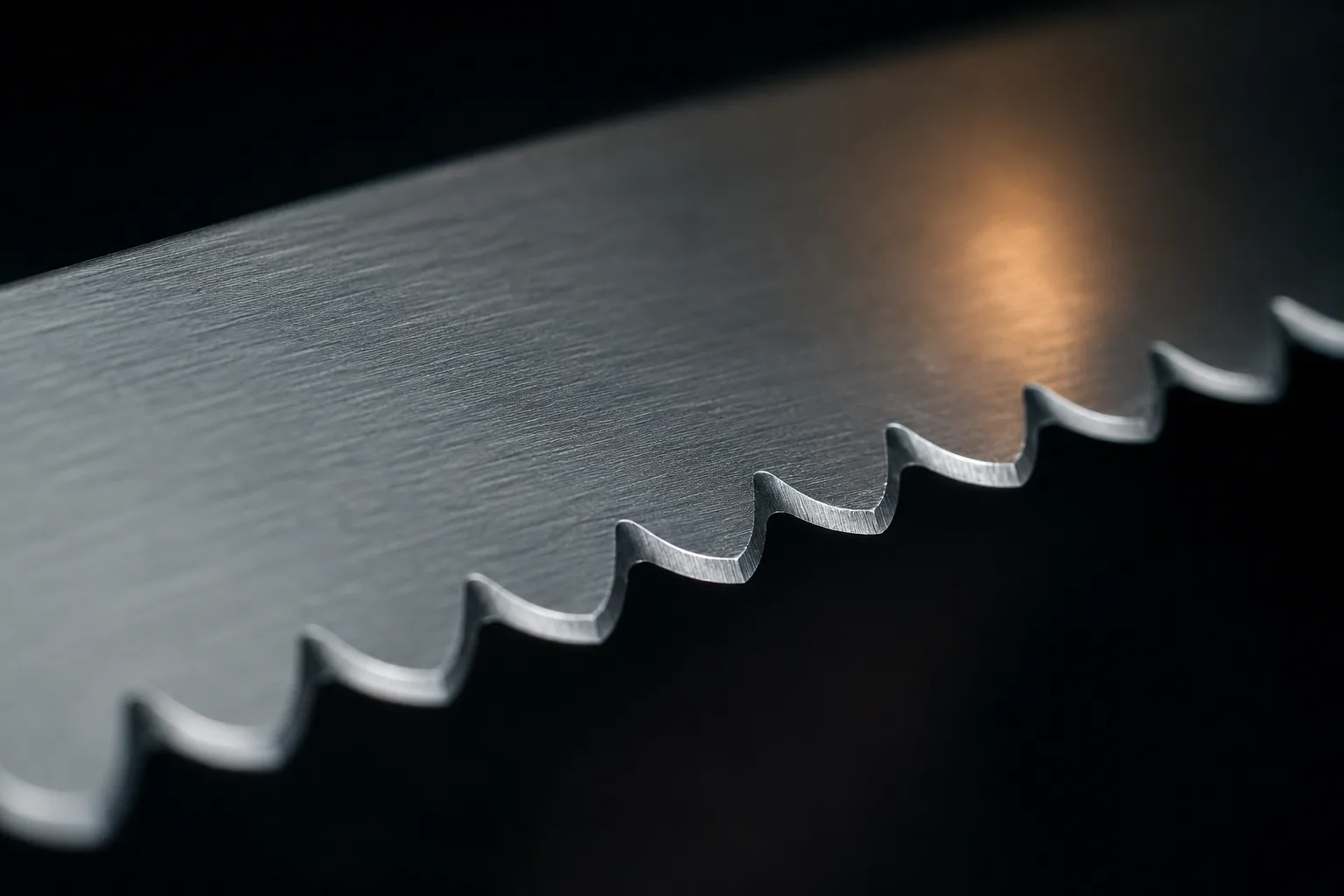
Now, try to imagine doing that to a serrated edge. It just doesn't work. Each "tooth" on a serrated knife is essentially a tiny, curved blade. Sharpening them properly would mean individually grinding each one, maintaining its specific curve and angle. It’s a painstaking, time-consuming process that requires completely different machinery and techniques than what we use for straight edges.
Most places that claim to "sharpen" serrated knives are actually just grinding down the flat side of the blade, or running a small, round file through the scallops. This might make the very tips of the teeth feel sharper for a moment, but it fundamentally changes the geometry of the blade. It flattens the profile, makes the teeth less effective, and ultimately shortens the knife's useful life.
The Mechanics: Straight Edge vs. Serrated Edge
To understand why we don't touch them, you need to understand the fundamental difference in how these knives cut.
Straight Edges: Push, Slice, and Precision
A straight-edge knife, like a Wüsthof chef's knife or a Global santoku, relies on a keen, unbroken edge. It works by wedging itself into the food and slicing through with minimal resistance. The perfectly ground bevels create a fine point that parts the material. This is where our sharpening process shines: it restores that precise, sharp geometry, allowing the knife to glide through food with a clean cut.
Think about slicing a raw carrot. A truly sharp straight edge pushes cleanly through, leaving smooth surfaces. It's about precision and efficiency.
Serrated Edges: Sawing and Tearing
Serrated knives, on the other hand, are designed to saw. Each tooth acts like a tiny point of pressure, breaking the surface of the food. The scallops between the teeth provide clearance for the material being cut, reducing drag as the blade moves back and forth. They don't slice in the same way; they tear and rip.
A common misconception is that serrated knives stay sharp longer than straight-edge knives. While it's true they can *feel* like they're still cutting when a straight edge would be completely useless, what they're doing is tearing. The points of the teeth might still catch, but the efficiency and cleanliness of the cut are long gone. Eventually, even the points dull, and you're left with a glorified dull saw.
What Serrated Knives Are Actually Good For
Despite our refusal to sharpen them, serrated knives do have their place. They excel at tasks where you need to break through a tough exterior and cut a soft interior without crushing it. Think about it:
- Bread: The classic use. The teeth grab the crust and saw through without squishing the soft crumb inside. A dull bread knife, however, just rips the crust and flattens the loaf.
- Tomatoes: A good serrated utility knife can break the skin of a tomato more easily than a dull straight edge. However, a truly sharp straight edge will slice a tomato with far more precision and less bruising.
- Roasts: Carving knives often have a slight serration to help grip and saw through tough meat and connective tissue.
They are tools of compromise. They sacrifice the clean, precise cut of a straight edge for the ability to power through materials that might otherwise slip or compress. But that compromise means they don't respond to traditional sharpening methods.
Your Options for a Dull Serrated Knife
So, if we don't sharpen them, what should you do with that dull bread knife or those tired steak knives?
1. Replace Them
For most home cooks, the simplest and most cost-effective solution is to replace a dull serrated knife. Unlike a good chef's knife, which is an investment meant to last decades with proper care and sharpening, many serrated knives are designed to be disposable. A decent Victorinox bread knife, for example, is relatively inexpensive and will perform well for several years before its teeth wear down.
Consider the cost of specialised serrated sharpening (if you can even find a service that does it properly). It's often higher than the cost of a new, mid-range serrated knife. For many, it simply doesn't make economic sense.
2. Learn to Live With Their Limitations
Some people accept that their serrated knives will eventually lose their edge and just live with it. For tasks like slicing bread where a perfect cut isn't paramount, a slightly dull serrated knife might still get the job done, albeit with more effort and a messier result.
However, if you're consistently frustrated by your serrated knives, it's a clear sign they're past their prime.
3. Prioritise Your Straight Edges
Instead of focusing on keeping serrated knives "sharp," focus on keeping your workhorse straight-edge knives in top condition. These are the knives you use for 90% of your kitchen tasks: your chef's knife, santoku, paring knife, and utility knife.
A truly sharp straight edge will often outperform a serrated knife even in tasks where serrations are traditionally used, like slicing tomatoes. The only exception is very crusty bread, where the sawing action of a serrated knife is genuinely superior.
Focus on What We Do Best: Straight Edges
At SharpenIt, our expertise lies in bringing straight-edge knives back to life, often sharper than they were when new. We handle everything from your everyday Victorinox paring knife to your prized Shun chef's knife or a traditional Japanese single-bevel like a Yanagiba (which, by the way, has its own unique sharpening requirements that we *do* specialise in, as you can read about in our FAQ section).
We are passionate about sharp knives because we know what a difference they make in the kitchen. They make cooking safer, more enjoyable, and far more efficient. Trying to force a dull knife to cut is dangerous and frustrating. So, while we can't help with your serrated knives, we can guarantee that your straight-edge knives will come back with an edge that glides, not tears.
Don't let dull knives make your kitchen a chore. Send us your straight-edge knives and experience the difference a truly professional edge makes.
Get your straight-edge knives professionally sharpened and rediscover the joy of effortless cutting. Order sharpening now.