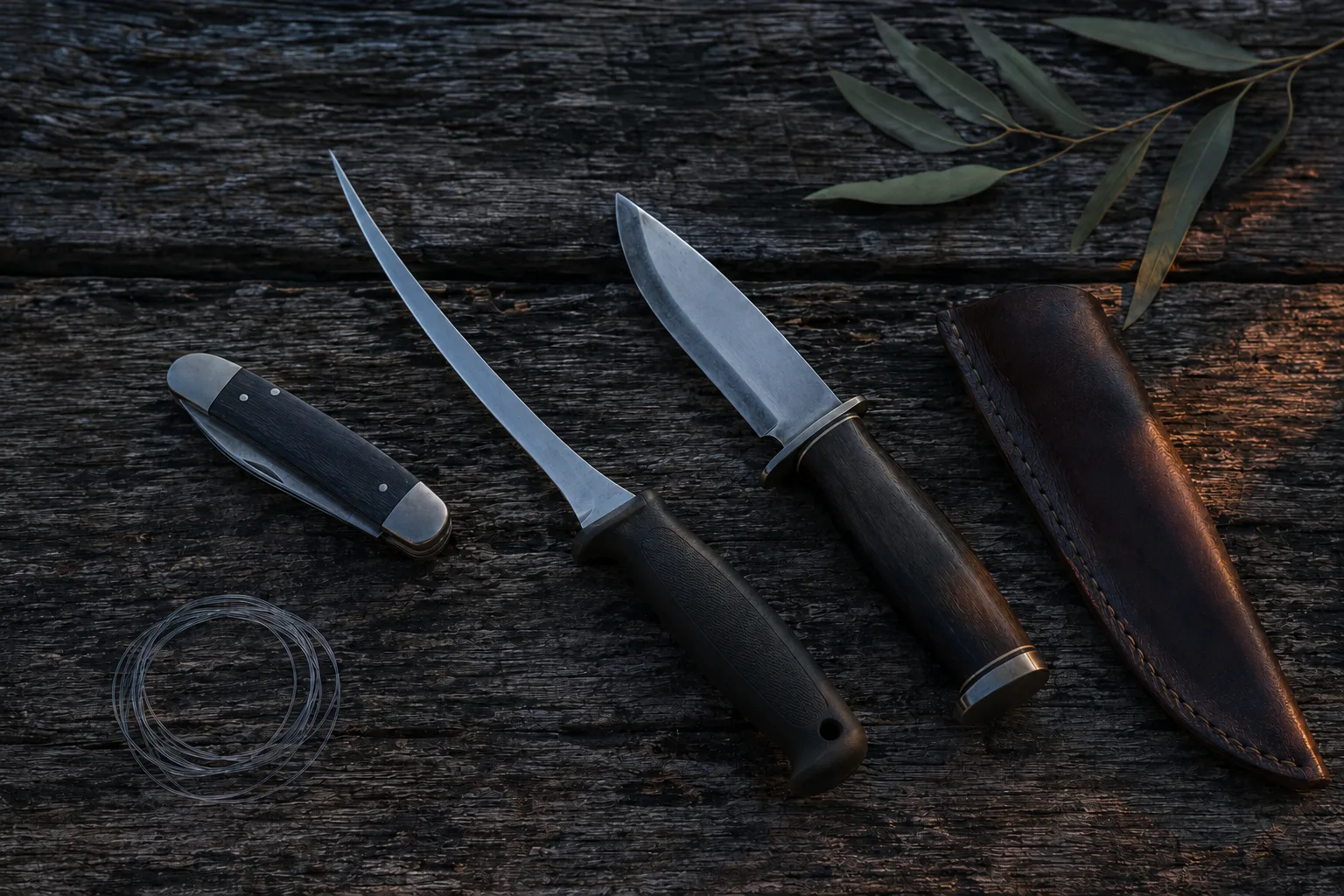
Bringing Pocket, Fishing and Fillet Knives Back to a Razor Edge
2026-07-19 · Emile
Some of the most neglected knives we get are the small ones. The pocket knife that's lived in a jeans pocket for a decade. The fillet knife that's gutted and fillited a season's worth of flathead on concrete cleaning tables and now tears more than it slices. The hunting knife handed down from a father, too good to throw out and too blunt to use. Thin blades like these are easy to write off — but they're some of the most satisfying knives to bring back, and they come home properly sharp.
Why thin blades get neglected
A blunt chef's knife annoys you every night, so it gets dealt with. A pocket knife or a fillet knife only lets you down now and then — on the boat, in the field, halfway through a job — and by the time you're home you've forgotten about it. So it sits. The irony is that these are exactly the knives where a keen edge matters most. A fillet knife that flexes along a fish's spine can't do its job blunt. A pocket knife you actually carry for a reason is worse than useless when it won't bite.
Thin steel needs a careful hand
There's a real reason people are wary of getting these sharpened. Take a slim fillet or pocket blade to a fast dry grinding wheel and the thin steel heats up in seconds. That heat draws the temper out of the edge — it turns blue, goes soft, and from then on it won't hold a point no matter how often it's sharpened. The knife is quietly ruined by the very thing meant to fix it.
We sharpen every blade on a slow, water-cooled wheel. The water keeps the steel cool the whole way through, so a delicate fillet knife or a fine pocket blade never gets near the temperature that would damage it. Thin, flexible knives are where this method earns its keep — the edge geometry stays true and the temper stays where it belongs.
Back to a razor edge
Once the edge is set on the wheel, we finish every knife by hand on a leather honing wheel. That's the step that takes a knife from "sharp" to the kind of edge that shaves hair off your arm and glides through the skin of a tomato under its own weight. On a fillet knife it means clean, effortless slices along the bone with no sawing. On a pocket or hunting knife it means it bites into a cut the moment it touches, the way a good knife should.
We don't reshape a knife into something it isn't — a working pocket knife gets a tough, practical edge that lasts, not a fragile razor that chips on the first hard use. The goal is a knife that does its job again, and keeps doing it.
Yes, you can post them
Pocket knives, fishing and fillet knives, and hunting knives all fall under our standard sharpening tier — the same per-knife price as your kitchen knives. And they're ideal for mail-in: they're small, they pack easily, and the prepaid satchel handles a handful of them at once. Slip your fillet knife in alongside the kitchen block and they all come back sharp in the one parcel.
If you've got a small knife you'd written off as past it, it's very likely not. Send it in and see what a proper edge feels like again.