Knife Heat Damage: Signs Your Blade is Ruined by Hot Sharpening
2026-07-20 · Emile
You’ve just had your favourite chef's knife sharpened. Maybe you took it to a local market stall, or a hardware shop that offers a “while-you-wait” service. It felt sharp for a day, maybe two, and then it’s back to sawing through tomatoes. Or worse, you look closely at the edge and it’s got a weird blue or straw-coloured tint, like someone took a welding torch to it. You try to sharpen it yourself, or take it back, but it just won’t hold an edge anymore.
Sound familiar? You’re likely looking at a knife that’s been ruined by heat damage. It’s one of the most common, and most frustrating, ways a good knife can be destroyed by a bad sharpening job. And once it’s done, it’s usually irreversible.
Let's talk about what heat damage looks like, why it happens, and how to make sure your knives never suffer from it.
How to Spot a Heat-Damaged Knife Edge
The signs of heat damage aren't always immediately obvious, especially if you're not looking for them. But once you know what to spot, it's hard to unsee.
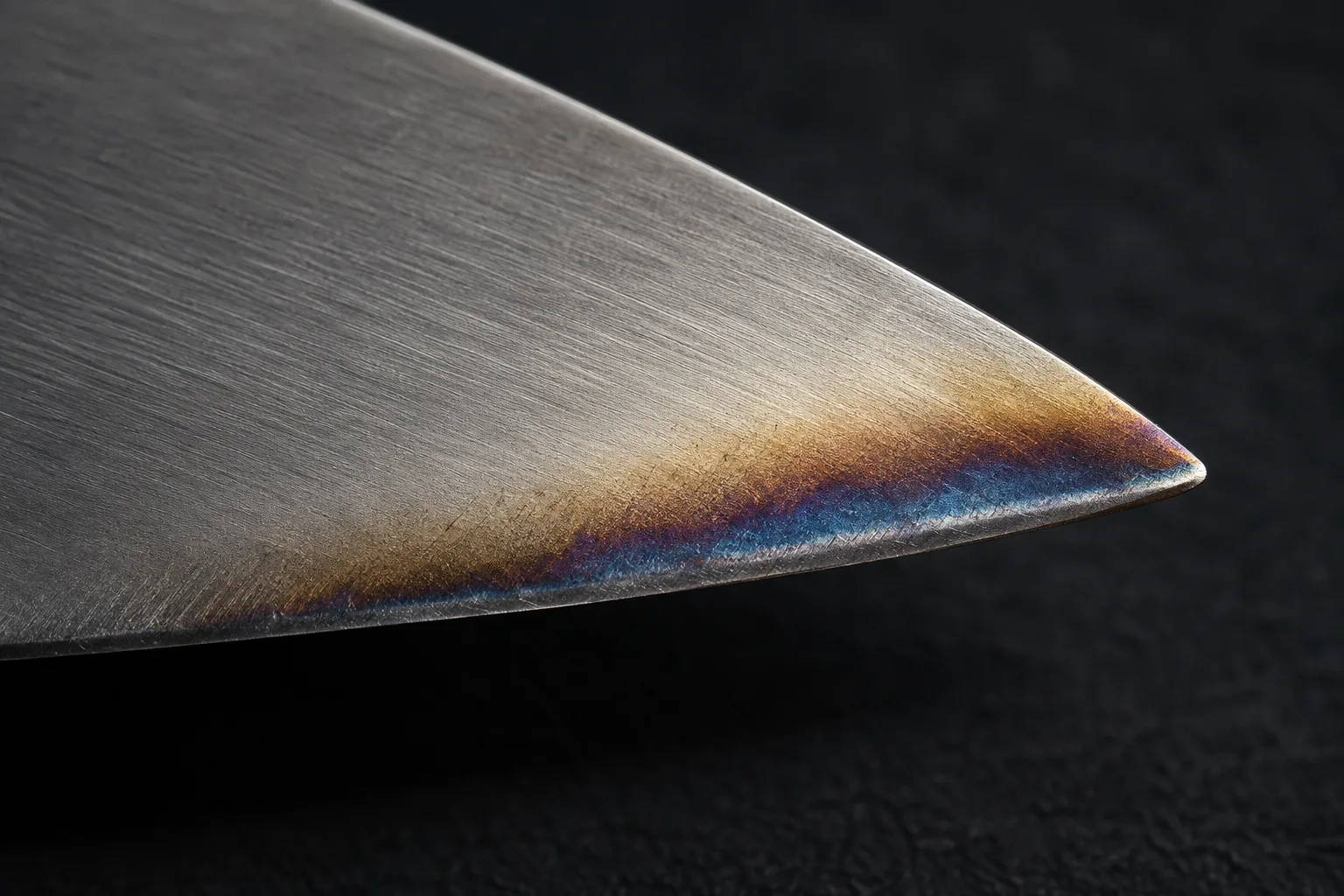
Visible Discoloration
The clearest sign is often a change in the steel's colour along the very edge, or just behind it. When steel gets too hot, its temper changes, and this can cause distinct colour shifts:
- Bluish or Purplish Hue: This is a dead giveaway. Blue or purple discolouration indicates the steel has been heated significantly past its tempering temperature. It might look like a thin line right on the cutting edge itself.
- Straw or Bronze Colour: Less severe heat damage might show up as a light straw, bronze, or even a rainbow-like sheen. This still means the steel's properties have been altered.
- Dark Grey or Black Scorching: In extreme cases, especially with cheap, high-speed grinding, the steel can even appear scorched, sometimes with an almost black, burnt look. This usually means the grinder was moving too fast and generating immense friction.
These colours aren't just cosmetic. They're a physical indicator that the steel's internal structure has been fundamentally changed.
An Edge That Won't Hold
This is the functional symptom. You get the knife back, it feels sharp initially, but within a few cuts, it’s dull again. You try to hone it, or even re-sharpen it, but it just doesn’t take a lasting edge. It might chip or roll easily, even on soft food. A Wüsthof or Global that used to hold an edge for months might now dull in a day. That’s because the steel itself has lost its ability to maintain a fine, strong edge.
Chipping or Crumbling Edge
If the heat damage is severe, the steel at the very edge can become incredibly brittle. You might notice tiny micro-chips appearing along the blade with very little use, or even just from touching it. The edge might feel "crunchy" or "crumbly" rather than smooth and keen. This is because the overheated steel has lost its toughness and flexibility.
The "Hot Grind" Problem: Why Cheap Sharpening Ruins Knives
Heat damage is almost always caused by friction from fast, dry grinding. Think about those services you see at markets or in hardware stores: often a bloke with a high-speed bench grinder or a fast-spinning belt sander. They whip your knife across it in a few seconds, sparks flying exerywhere. Fast, convenient, and cheap. But it's also a recipe for disaster for your good knives.
Here’s why:
- High-Speed Friction: When metal rubs against an abrasive at high speed, it generates a huge amount of heat. Fast bench grinders, especially, can heat the edge of a knife past its critical temperature in literally seconds.
- No Cooling: Most of these quick services use dry grinders. There's no water or coolant to dissipate the heat. All that friction-generated heat is concentrated right on the thin, vulnerable edge of your blade.
- Inexperienced Operators: Many operators of these services are not trained knife sharpeners. They might be general handymen or salespeople. They focus on speed and visible sparks, not on preserving the integrity of the steel.
It’s a shortcut that saves time and money for the sharpener, but costs you a good knife. This is especially true for quality knives from brands like Shun, Wüsthof, or Global, which rely on precise heat treatment for their performance.
The Science Behind the Ruin: What Heat Does to Knife Steel
To understand why heat damage is so bad, you need to know a little about how knives are made. Every quality knife steel, whether it's a high-carbon stainless from Victorinox or a premium Japanese VG-10, undergoes a specific heat treatment process during manufacturing. This process involves heating the steel to very high temperatures (hardening) and then cooling it, followed by a lower-temperature treatment called "tempering."
Tempering is crucial. It relieves stress in the steel, makes it tougher, and prevents it from being too brittle. The specific temperature and duration of tempering dictate how hard and how tough the final blade will be. Every steel has an optimal tempering temperature range.
When a knife edge is subjected to excessive heat from a dry, fast grinder, it pushes the steel past its tempering temperature again. This effectively "re-tempers" or "over-tempers" that tiny section of the blade. What happens?
- Loss of Hardness: The steel becomes softer. A softer edge can't hold its shape against the forces of cutting, so it rolls, dulls, or chips much more easily.
- Grain Structure Changes: The microstructure of the steel changes. The carefully arranged carbides and other alloying elements that contribute to edge retention can be altered or dissolved, leading to a weaker, less stable edge.
- Internal Stresses: Rapid heating and cooling can also introduce new stresses into the steel, making it prone to cracking or micro-fractures.
Essentially, that quick pass on a hot grinder undoes the careful work of the knife manufacturer, permanently degrading the steel right where you need it most – at the cutting edge. It's like baking a cake and then putting it back in a super-hot oven for a minute; it's not going to improve the cake.
How SharpenIt Prevents Heat Damage: The Water-Cooled Difference
At SharpenIt, avoiding heat damage isn’t just a benefit; it’s fundamental to our process. We use a slow-turning, water-cooled sharpening system. This isn't some fancy marketing term; it's a proven method used by professional butchers, woodworkers, and even surgical tool manufacturers who demand precision and edge integrity.
Here’s how it protects your knives:
- Zero Heat to the Edge: The key difference is the water. The sharpening wheel runs constantly through a trough of water, keeping the blade cool throughout the entire sharpening process. This physically prevents the steel from ever reaching temperatures high enough to alter its temper. Your knife’s factory heat treatment stays completely intact.
- Consistent Angle, Every Pass: We pair this with a precision angle jig. This jig holds your blade at a fixed, consistent angle against the wheel. This means we create a perfect bevel geometry every single time, without any rounding, scalloping, or over-grinding that can weaken the edge. It also means your knife gets sharper, faster, and lasts longer because less metal needs to be removed.
- Polished, Not Just Abraded: After the water-cooled grind, we finish every knife by hand on a leather honing wheel with polishing compound. This step refines the edge further, removing any microscopic burrs and leaving a mirror-polished finish. This is the difference between "sharp" and "razor sharp" – an edge that glides through paper and shaves hair. Most budget services skip this critical step, but it's essential for a truly keen and durable edge.
This method ensures that when you get your knives back from SharpenIt, they're not just sharp; they're properly sharp, with their steel integrity fully preserved. We don't take shortcuts that compromise your tools.
If you're ever unsure about a sharpening service, don't be afraid to ask about their method. A reputable sharpener should be happy to explain their process and how they prevent issues like heat damage. It's a simple question that can save your favourite knife from permanent damage. You can read more about common sharpening myths and our approach in our FAQ section.
Can a Heat-Damaged Knife Be Saved?
This is the tough question, and the honest answer is often "not completely." Once steel has been overheated and its temper permanently altered, you can’t simply reverse it. The molecular structure has changed, and it won't ever perform like new again.
In some rare cases, if the heat damage is very shallow, a highly skilled sharpener might be able to grind away the damaged section of the steel. However, this usually means removing a significant amount of metal from the blade, which can drastically shorten the knife's lifespan or change its geometry, especially for thinner blades. For most kitchen knives, the amount of metal that would need to be removed to get past the damaged area isn't practical or worth it.
Prevention is always better than cure. Protecting your knives from heat damage in the first place is the best way to ensure they last a lifetime and perform their best.
Don't Gamble With Your Good Knives
Your kitchen knives are essential tools. Whether it's a workhorse Victorinox chef's knife or a delicate Japanese santoku, they deserve to be treated with care. Don't risk permanent damage from cheap, fast, dry grinding services that prioritize speed over precision and steel integrity. Trust a service that understands knife steel and uses methods designed to protect and enhance your blades.
Ready to experience true, lasting sharpness without the risk of heat damage? Let us sharpen your knives properly. Order your knife sharpening service today.